How Turbo-Cancers are Triggered
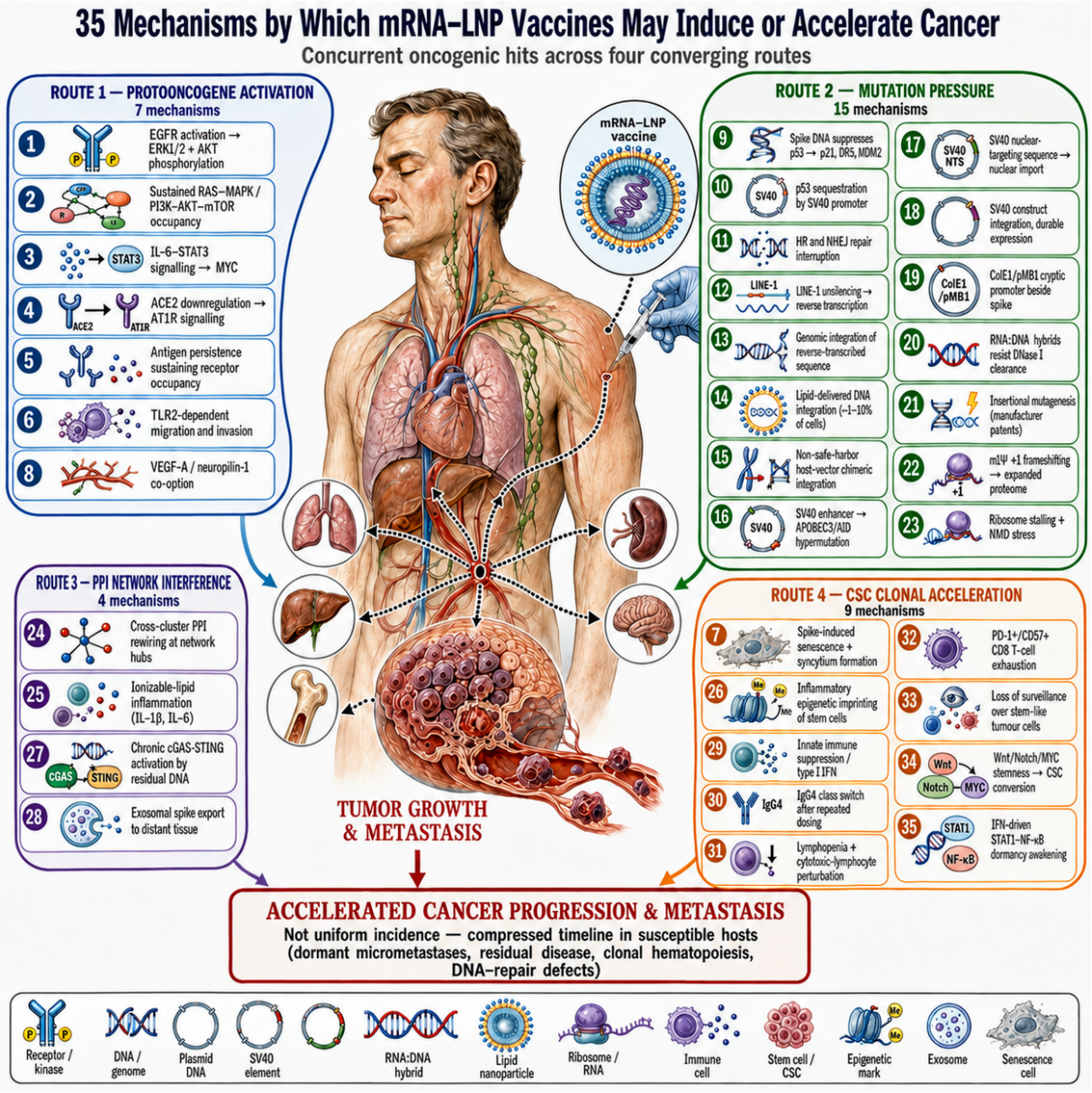
A paper from Zenodo.org highlights 35 mechanisms thought to contribute to the surge in 'turbo-cancers' being seen since the mRNA COVID vaccines were implemented. Most of these pathways are not specific to the COVID-19 shots but are relevant to the mRNA/lipid nanoparticle (LNP) technology used to disperse the payload into the body.
This work builds on the published research of many studies from a wide range of authors, and is an attempt to organize that information in an attempt to gain an overall view of the issues.
The human immune system is incredibly complex, and there is still much to understand. Below, I've attempted to explain (simply) the four major routes of cancer proliferation described in this paper just to give you an idea of the processes. However, the individual mechanisms, and the research papers describing them (referenced in the PDF document), are not something likely to be understood by anyone not steeped in these branches of medical research.
General Categories of Cancer Induction or Acceleration
- Route 1 – Proto-oncogene Activation: (7 mechanisms)
There are genes as part of your DNA that regulate cell growth, proliferation, and differentiation (changes to various specializations). As with most genes, you have two copies: one from each parent, and they may differ. If one copy (and it only takes one) becomes modified, it can undergo a sort of gain-of-function that causes a disruption of the way that gene is expressed, resulting in runaway cell growth, massively increased numbers of that cell type being produced, and/or changes in those cells' behaviours.
- Route 2 – Mutation Pressure: (15 mechanisms)
You may have heard that human tissues contain millions of potentially mutated, cancerous cells; yet they don't grow into tumors. Normal physiology does not support the conditions that allow for uncontrolled growth and replication of these cells. However, if massive numbers of the same mutation are induced by some factor, or there is a disruption of the normal control mechanisms (such as from constant inflammation, injury, nutritional deficits, etc.) the affected genes are much more likely to have a greater effect.
You may be surprised to learn that some mutations can be a benefit to an organism; but only during times of stress when some kind of adaptation is required. When times are good for the organism and no adaptation is needed, it is almost never helpful for mutations to become dominant.
- Route 3 – PPI Network Interference: (4 mechanisms)
Protein-Protein Interaction (PPI) is the concept of how different proteins interact with each other to affect cellular processes during normal cell functions and metabolism. Mutations, viral proteins, and other types will bind to one another to cause certain effects. If the way the binding takes place changes, it can change the outcome of the interaction. The changes may include:
- Loss or weakening of interactions: functions affected might include tumor suppression, repair of damaged DNA, or triggering the dissolution of a rogue cell.
- Gain-of-function: A new pairing of a mutated protein might increase invasiveness or resistance to a therapy.
The result is that new biological pathways appear, in effect, rewiring the normal network behavior.
- Route 4 – CSC Clonal Acceleration: (9 mechanisms)
Cancer Stem Cells (CSCs) are a subset of tumor cells that reproduce faster and therefore change the characteristics of the tumor as a whole. Because they are quicker to adapt, treatment will often destroy the slower-growing cells involved in the tumor, but leave these more prolific varieties to regrow the tumor with the more aggressive type.
